
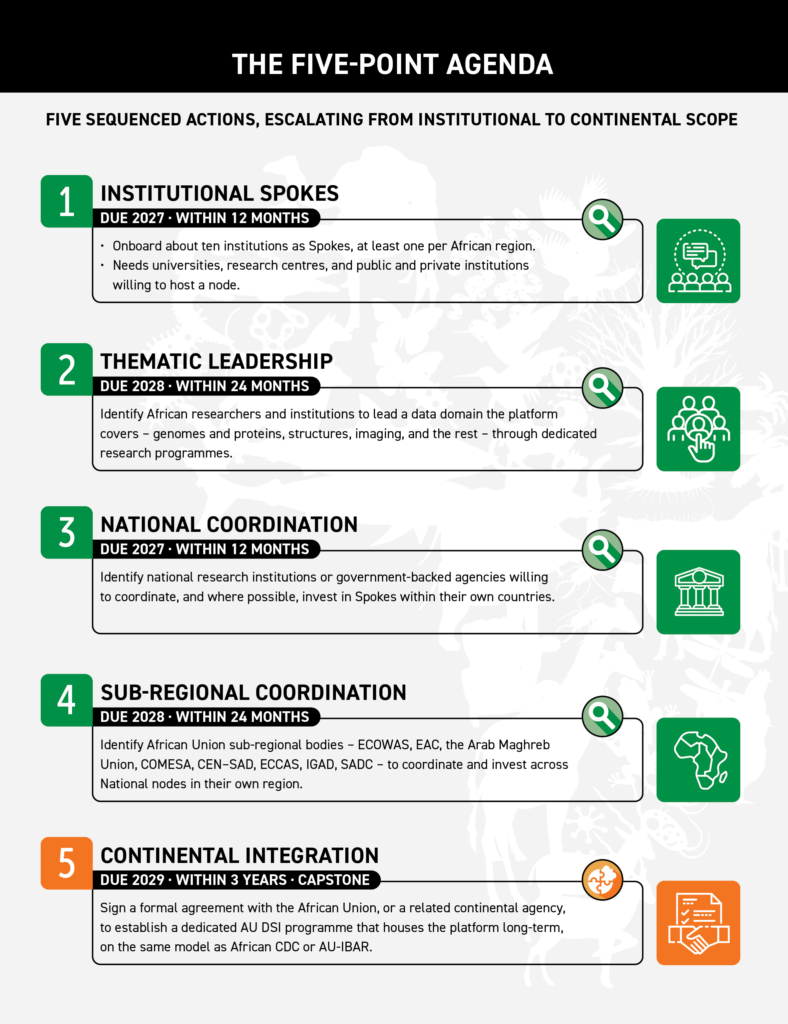
The African DSI DataBank (http://africandsidatabank.africa) launches as a federated infrastructure for Digital Sequence Information (DSI), marking a landmark achievement in creating a new home for Africa’s genomics and biodiversity biomolecular data as described in the recent commentary article, “The African DSI DataBank: a federated infrastructure for Africa’s genomic and biodiversity data”, published in the journal Nature Reviews Genetics. This achievement supports the implementation of the African BioGenome Project (AfricaBP) roadmap for biodiversity DSI across Africa, including its five-point agenda for establishing and linking a network of African biodiversity biomolecular infrastructure from institutional to continental integration (Figure 1).
Prior to the launch, the gap in Africa-governed infrastructure was highly pronounced. Despite holding roughly a quarter of the planet’s biological diversity, the ownership and representation of that data was highly inequitable at only 4.9% compared to 22% for Europe, 23.6% for Asia, and 31.1% for North America. As an Africa-led and hosted infrastructure, the African DSI Databank will host, curate, analyse, and enable researchers to study and govern access to African-origin DSI for biodiversity and agriculture. This new home for African data is also rooted in equity, providing visibility, citability, interoperability, and institutional sovereignty for all the data it hosts.
Navigating the African DSI Databank
The African DSI Databank is expected to host up to 11 kinds of data, from genomic and transcriptomic data to protein structures, eDNA and biological imaging, as well as provide opportunities for African researchers and institutions to request compute time and space. Regardless of the data type, each record is traceable to the source institution from which it originated. Records carry clear provenance, a citable identifier, and an auditable model that defines how data is accessed and shared. The African DSI DataBank does not adjudicate access and benefit-sharing (ABS) since there are already African institutions mandated to do this; rather, it connects to a third-party ABS Service to support ABS processes by making ABS compliance and analytics easily discoverable, allowing African policymakers to make informed decisions.
A Continental Hub provides a public catalogue of the data and sits at the heart of the Databank. The Hub connects records across Africa, from sub-regional, national, and institutional nodes. Each node is a point of origin for the data it holds and controls, even if the data is shared within the wider federation. This provides local control regarding decisions about sharing the node’s data while allowing the federation to still be administered centrally.
In addition, the platform is interoperable with global DSI infrastructures, especially for data sharing tiers classed as public and where an institution provides explicit consent. Data and information classed as private and restricted are never interoperable with global DSI infrastructure. By connecting to global infrastructure and resources already available through, amongst others, National Center for Biotechnology Information (NCBI), European Nucleotide Archive (ENA), DNA Data Bank of Japan (DDBJ), Universal Protein Resource (UniProt), Protein Data Bank in Europe (PDBe), PubMed, AlphaFold Database, and KEGG, the platform identifies and mirrors records of African origin already held in these international platforms and cross-references them with new biomolecular data expected to be added by the platform’s nodes. Lastly, the platform can submit public genome records to the ENA after receiving explicit consent from the originating institution while preserving the institution's attributions.
The right advancement at the right time
Since 2022, AfricaBP has set out to build shared genomics and bioinformatics infrastructure across the continent – the African DSI DataBank marks the first practical delivery of that goal. Similarly, in 2024, the Convention on Biological Diversity’s Decision 16/2 opened a multilateral benefit-sharing mechanism for DSI. This decision placed leverage behind the simple question: who is actively generating, holding, contributing, and benefiting from DSI, and how can we clearly define this? The African DSI DataBank answers that question with evidence – trusted and reliable information on which institutions and countries are contributing, how that contribution is growing, and how the resulting data is actually being used. More importantly, the DataBank places Africa in the driver’s seat of data sovereignty rather than a victim of inequitable structures built to benefit others from the rich, local specimens contributing to 25% of the world’s biodiversity.
How to get involved
Explore the catalogue: No account is needed to browse species records, genomes, structures, or the platform’s own real contribution statistics.
Apply to run a node: Any African institution, a single research group, a national coordinating body, or any entity in between, can apply to operate its own node and begin contributing data under terms it controls, on infrastructure sized to what it can realistically run.
Lead a thematic area: The platform is looking for specialists to help lead and enrich specific data domains — eDNA, metagenomics, genomics, bioimaging, protein structures, chemical profiles, and more.
Run compute against it: Search across the Hub and any connected node at once, or bring an existing analysis service into the federation through the platform’s own documented integration contract.
Request access: Request access to any data with restricted tier access
Tell us what’s broken: The platform publishes a capability-maturity account — what’s live and verified, what’s built but not yet proven at scale, and what’s still a deliberate placeholder. Feedback, bug reports, and feature requests are always welcome through the platform’s own contact form
Join the mailing list: https://hub.africandsidatabank.africa/
Sponsor the African DSI DataBank: Sponsor the Continental Hub or any of its nodes to foster regional and continental integration. Sponsorship accelerates continental mainstreaming and helps establish inter-African governmental agreements that embed the DataBank into policy frameworks for long-term sustainability.
African genomic and biodiversity data has, for too long, had no authoritative place of its own. Now it does. It is time to take action – for institutions, researchers, companies, funders, and policymakers – to utilize the DSI Databank, contribute to its growth, and help it uphold the standard of African excellence.
Learn more: https://hub.africandsidatabank.africa/
African DSI DataBank Media & partnership enquiries: info@africandsidatabank.africa
Related links:
The Next Frontier for African Genomics – Safeguarding African Biodiversity
Accelerating knowledge exchange in biodiversity genomics and bioinformatics
Establishing African genomics and bioinformatics programs through annual regional workshops
Expanding African biodiversity genomics to meet global biodiversity goals
AfricaBP media team:
Hawwa Gabier
Member, Communication and Public Affairs Sub-committee
African BioGenome Project
Fatu Badiane, Ph.D.
Chair, Communication and Public Affairs Subcommittee
African BioGenome Project
Contact: info@africanbiogenome.org
Website: https://africanbiogenome.org
About AfricaBP:
The African BioGenome Project (AfricaBP) is a coordinated pan-African effort to build capacity (and infrastructure) to generate, analyze, and deploy genomics data for the improvement and sustainable use of biodiversity and agriculture across Africa.